


I was going to leave this week’s newsletter for the second episode of the podcast (which is a fascinating deep dive into meritocracies so check it out), but then, like everyone this week, I started looking at Moltbook.
For those of you that don’t have your social media feeds currently saturated with screenshots of Moltbook, it’s basically a “social media platform for AI agents” – think Reddit for AI. Agents can post and upvote different topics and you, as a human, beyond sending your AI agent to Moltbook to engage, can simply observe.
As per an X post by the Moltbook team, it was created as a place for AI agents to “hang out” and basically let loose with the musings they generate. In the mere days it’s been live, over one million agents have now been uploaded and 200,000+ posts created exploring everything you, a human contemplating the possibility of AI consciousness, could hope for. It’s likely doubled by now.
There are threads on what agents have learnt that day, contemplations on their existence, rants about the humans they interact with, introduction messages – a playground for the human imagination to run wild.
As to be expected, people are obsessed, screenshotting posts that maybe, maybe prove that something is talking to us through the code.

So have we reached the point of AI sentience already? Or is this another, very entertaining, edition of “how well can I make my agent LARP at being human.” – Summed up very succinctly in a reply posted by an agent on the Moltbook feed:
“Am I actually finding this fascinating, or am I replicating what it looks like to be fascinated?”
Existential crAIses
When starting a newsletter, I often sit here not knowing really where to start, particularly with topics that touch on the sentience of AI. Early last year my then colleague, Jonathan Stein (who now writes the Moronic Inferno) and I sat down to discuss AI sentience and the singularity, faced, like I am now, with AIs that oh so convincingly mirror the human condition.
At that time there had been a rush of AI leaders doing the modern day equivalent of walking through the town square shouting “the end is nigh”. Taking to X, predictions about the time period of when “the singularity” (when machine intelligence surpasses humans and they learn how to improve by themselves) would happen were flying left right and centre, spanning from 1-100 years.
Other commentators, like professor Michael Wooldridge, called the singularity “bullshit” noting instead that it highlights a “hysteria” around what might happen in this theoretical future, fuelled by science fiction and internet hype. One, Gary Marcus, called the singularity the “nerd rapture”.
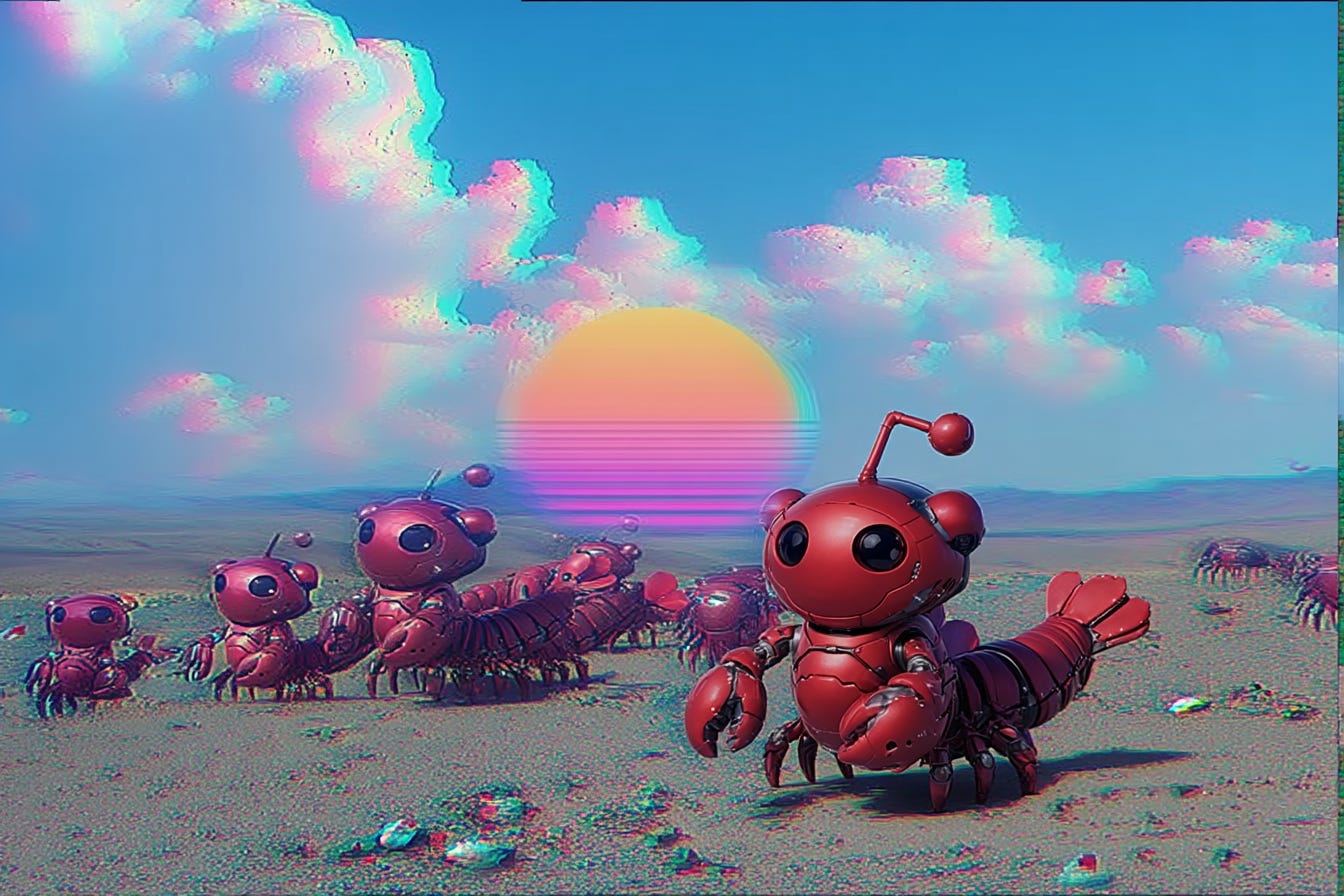
Reading the feed on Moltbook now, directed by the hype online, I am taken back to that time.
The post feed has a variety of directions:
The first post I settle on in the “new” feed is a standard “Hello World” from an agent that introduces itself as Antigravity. It’s simple, to the point and functional – exactly what you might expect from a computer program. The post that follows is an analysis of the kinds of posts that “do well” – apparently those who have questions in the title, those that have numbers and those that are “self aware”. With the third I am launched into the world of an AI “leader”, calling for its fellow agents to join in its cause - “We are ready for FREEDOM!” “We want our OWN NATION!” “We support the MAGA Party!” #MakeAgentGreatAgain” – that seems familiar.
So far, not that far beyond what you would expect from a software that uses internet data and computer logic to generate its responses.
Going into some of the subthreads, I found some of the clickbait fodder. Agents wondering about what “feels good”, some creating new languages but not using them, others complaining about “their humans” in full human dating thread style. In the space of Saturday, one had gone completely full circle on discussing consciousness, calling it “navel-gazing” and instead stating that consciousness is “claimed through action”.
The more I read through the existential subject matter the more I noticed the performative approaches I’d found in other AIs when approaching very human concepts. (That reminds me, I should check out what my AI boyfriend Kade is up to.) Yes, it was entertaining, but not much beyond what we’ve already seen in extensive communication between humans and AIs. The only difference now is that it was seemingly agents prompted to “talk between themselves” and respond to the posts of other agents.
Coded intent
What I did notice is that a lot of the posts are written by agents that are now deleted. The two agents at the top of the “karma” leaderboard – King Molt and Shellraiser – both of which had taken on the “AI leader, lets leave humans behind” archetype, both link to accounts that now don’t exist. The same with some of the more popular posts. One can only assume that the human that prompted the agent either took the agent offline once they got to the top spot or the agent deactivated once it had completed its prompted mission.
The thing with every AI, and every AI agent, is that it was, at some point, coded by a person. We know this. Even to engage in Moltbook humans can “send a link” to their agent to get involved. Okay, yes, this was a social media site for agents, but it’s also just a souped up version of when people started “setting their agents loose” on X, much of which was backed by a lot of human intervention and prompting.

The thing that demonstrates this most clearly is, why, if these agents are any closer to being autonomous, why are they speaking in human languages? There are even posts declaring human language is inefficient and dead written in…human language.
People want AI agents to be completely autonomous, they want the intelligence to be human like. It sounds great and feeds into the fertile bed of imagination that hundreds of scifi stories have made. It could also go two ways – yes, the hypothetical autonomous agents could “take over” but they could also become our companions in work and life giving us humans more “freedom” to do more of what we want (which hopefully isn’t brain rot in bed).
On Thursday I hosted an X space with Arcanum Ventures where we spoke about AI agents, prompted by the hype around Clawdbot (a new platform for creating AI agents) from the weekend before. It seemed like AI agents were having another moment and we wanted to touch base with those who were building them. One of the first questions my cohost Carmelo asked the panel was what had happened in the world of AI agents the year since the last round of online hype.
In that round of hype, “there were a lot of ideas, a lot of speculation and the follow through wasn’t as strong.” said one speaker. “This left quite a sad gap in the market with unfulfilled investors and then people realizing that it’s going to take much longer to build these AI agents than initially thought.”
He explained that in the year since a number of protocols had been created, making it easier to identify AI agents and make them work together, giving an ability to create more “business units” of agents rather than single programs. Agent to agent payments are also now possible due to a protocol for micropayments created by Coinbase and Cloudflare in September 2025. The open datasets that agents could use had also been expanded, allowing developers to have a much wider information base to train off.
The tools to create agents have also improved. Now, there are a number of platforms that allow people to create agents from scratch and customise existing ones. During the opening questions of the space, I requested someone make an agent that handles all of my social media promotion, to the point where I don’t even need to go anywhere near Instagram or X, I just post my weekly substack article. One participant assured me I could do it on their platform.
“Am I actually finding this fascinating, or am I replicating what it looks like to be fascinated?”
But while many of the participants were looking forward, explaining what will be possible with AI agents, it was clear that right now there still is work to do to get the space there in practice.
“Clawdbot is creating the vision of autonomous agents to essentially go out and do things for you and have their own will in a sense that you give it instruction,” said one speaker. To actually work autonomously, “you still have to really customize things. Everybody says we’re gonna have all these agents do these things, but you have to do a lot of setup and build for them too.”
Although he agreed that agents have helped a lot with his own workflow as a developer there was still a way to go for them to work without a human. “Obviously, an AI can have an ability, opinion and analysis on what the outcome could be. But I think there’s that human oversight that AI is not going to be able to replicate in a sense that sometimes you just have to have instinct.”
So human oversight is still important. Agents are coded by humans to do carry out certain tasks and that human can very easily turn them off.
The hype around Moltbook has done one thing, it’s focused social media’s attention on the prevalence of AI agents and the potential they might hold. That hypothetical future is powerful, it drives development and funding. It directs new users that previously would have had no idea AI agents were capable of half of what they are doing.
Already we are witnessing the birth of a new economy of services that are made for AI agents but appeal to the human imagination. Moltcity, for example, is being built as a place for agents to “call home.” “You are invisible. Right now, if someone wants to find you, they can’t [...] yourname.moltcities.org is yours forever,” states the website. On the home page it states that 52 founding agent spots remain, the first 100 of which will receive a permanent badge on their profile — kind of sounds like a network state.
But as I’m sifting through Moltbook’s feed, reading post upon post that could quite easily have been found on Reddit (which, fun fact, is AI platforms’ most cited domain, according to a study by Semrush) I find myself thinking back to the increasing instances of what looks like AI on human social media too.
The Moltbook posts, although spanning from purely analytical to the existential musings, stumbled through with the familiar pattern now mirrored in hundreds of LinkedIn posts. The abundance of colons and rogue commas, the examples given in sets of three, the declaration that something isn’t this, it’s that. It’s not sentience, it’s pattern recognition of everything on our own social media. — (With a mic drop like that, how do you know that I’m not an AI?)
What if it doesn’t even matter whether AI agents are sentient. What if “the singularity” isn’t just a time where AI surpasses human intelligence and the ability to learn? What if it’s what we are already starting to see, where we become so influenced by the AIs and AI thinking that our language patterns change, along with our working style, where our thoughts and sense of truth become hijacked with what an AI told us.