

Dare to Dream
How “creating dreams” in small scale experimental towns may open the realm of innovative possibility to larger jurisdictions

Slightly sleep deprived and my head full with (much welcomed) Bitcoin 2026 optimism, I grabbed a taxi to an unassuming bar off the Las Vegas strip.
The dark room, with reggaeton blaring and plastic wrapped booths momentarily threw me back to the Canarian discotecas of my youth, but I wasn’t there for dancing. I’d come to hear about the story of Bitcoin Beach, the El Salvadoran experiment in the coastal town of El Zonte, that sparked a revolution in the country’s approach to legal tender.
“Bitcoin beach was the only physical place that showed that bitcoin is more than a technology, more than an asset,” said Roman “Chimbera” Martinez, one of the pivotal figures in establishing the project. “Bitcoin is that tool that we were looking for.”
The project began in 2019 when an anonymous American donor wired Bitcoin to Mike Peterson, an American expat running an NGO in El Zonte. Rather than convert it to dollars, Peterson and Martinez decided to build something with it – a circular economy, the first of its kind, in a town of around 3,000 people where most had never held a bank account. The ambition, from the beginning, was not simply to introduce a new payment method but to prove that an entire economic ecosystem could run on it.
Young people were hired to do community work and paid in Bitcoin over the Lightning Network. Local businesses started accepting it. When the pandemic hit and the formal economy collapsed around them, the project expanded. People received wages in it, paid electricity bills with it, sent it abroad and received remittances through it, bypassing the Western Union fees that used to consume a significant chunk of what families sent home.
What happened next was the part no one had planned for. Jack Mallers, the founder of Strike, posted about El Zonte on social media. The posts reached Nayib Bukele, El Salvador’s newly elected president, who was already looking for ways to distinguish his young administration. In June 2021, Bukele announced at a Bitcoin conference in Miami that El Salvador would become the first country in the world to adopt Bitcoin as legal tender. The Bitcoin Law, passed by the Legislative Assembly that same month, mandated that all businesses accept it as payment, launched Chivo, a government-built wallet, and offered every Salvadoran citizen thirty dollars in Bitcoin to download it. Within weeks, a coastal town of 3,000 people had seeded a national experiment watched by the entire world.
The place of dreams
For the rest of the world, El Salvador’s adoption of bitcoin has been an economic success story, but for those on the ground, its biggest impact was on the mentality of the people who took it on.
Before the project, young Salvadorans grew up understanding, implicitly, that their future would have to be built somewhere else. The dream wasn’t to build something in El Salvador. The dream was to leave.
“We were seeing our kids dreaming to leave the country,” Chimbera said. “Thinking that our country could not provide opportunities and hope for us.”
El Salvador had long been defined by its problems of gang violence, poverty and an economy that offered limited formal employment to people without connections or capital. But Bitcoin Beach, in Chimbera’s telling, made staying feel like a choice rather than a failure. “For the first time, we’re dreaming,” he said. “For the first time we had hope.” He paused, then added, “I don’t want to live in the USA. I see my future in El Salvador. And 10 years ago, for a Salvadoran to say that, it would be impossible.”
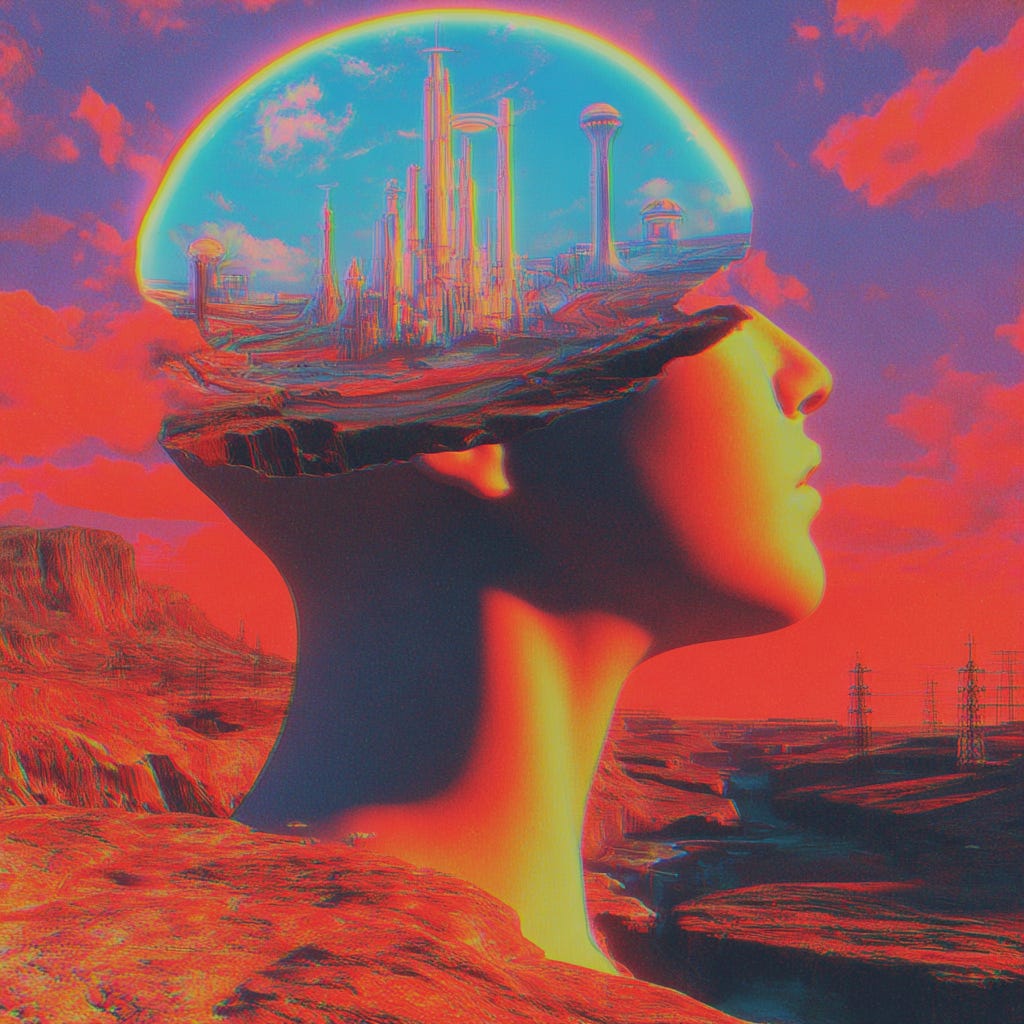
The mechanism, he believes, is through opening a door, not necessarily making people walk through it. “A kid that has dreams, it’s a kid that’s opening a door,” he said. “I’m not saying it’s going to be possible. But that door is open.” And with it comes a restoration of the possibility to create something different.
I’m now back in Europe, the flashing lights, painted skies and windowless halls of Las Vegas left behind in a neon blur, but the idea of “creating dreams” has stuck with me in the days and long plane rides since.
In 2009 political and cultural theorist Mark Fisher wrote about “capitalist realism”. In his specific framing, he writes about how capitalism has infused the collective thought so completely, that it’s impossible to imagine anything else. “It’s easier to imagine the end of the world than the end of capitalism,” he writes, and, as a Marxist, the book is written as a pillar of anti capitalist thought. But, whether you’re anti-capitalist or not, the idea of being unable to imagine more than what already exists, in my mind, prevails in modern society.
Focusing on the idea more abstractly, we can regard it as the pervasive feeling that it is easier to imagine the end of the world than the end of the current order, that the dominant culture has become exhausted, self-referential and incapable of producing anything genuinely new. The symptoms are visible in what Fisher described as a “slow cancellation of the future,” the inability to imagine alternatives that are not simply arrangements of things that already exist.
It’s seen in the engagement in two party political systems, despite not identifying with the policies of either, in the upholding of traditional institutions whose prevailing bureaucracy destroys the possibility of new treatments or tools coming to light, in the acceptance of and engagement in an attention economy that has been proven to reward polarisation and divisiveness.
Bitcoin Beach is an interesting case study because of its wider impact. The small scale experiment, focused on a tiny coastal town, proved its worth and evolved into an economy of bitcoin-infused, self sovereign businesses.
“It’s amazing how people in El Salvador are building on bitcoin,” said Juan Alejandro Diaz, founder of the Bitcoin Association in El Salvador. “In the fiat world we have upwork. In El Salvador we have Bitas. In the fiat world we have Uber. In El Salvador we have Bitride. In the fiat world we have the Apple store and we have the Bitcoin hardware store, and in El Salvador we have Bitcoin banks.”
Bitcoin Beach created a counter-narrative, one powerful enough to make people look at a place and think, maybe this is somewhere you can build a different future.
Proving another path
Bitcoin and digital assets are significant because they offered another path, not only to the flawed financial system bitcoin was built in light of, but other traditional institutions. For example, in my case, the first time Web3 really clicked was within the potential of NFTs to improve on the institution of Fine Art. A few years prior to my first foray into digital assets I had left the world of fine art, disillusioned by the abundance of gatekeepers and the lack of ownership artists had over their own success.
It seemed to me at the time that no matter how talented an artist was, if they didn’t fit into the prevailing zeitgeist of the art world, they were destined to fail. Instead of talent or a well thought out concept driving their ability to make a living from their work, it was who they knew, what they said publicly and whether it aligned with the select few at the top who made funding decisions.
The eventual, return driven, NFT hype cycle aside (and whether you like the aesthetics of some of the collections or not) NFTs provided a mechanism for artists to directly find their niche of collectors, unfettered by the opinions of an elite.
Both NFTs and Bitcoin provided, at the beginning, small scale examples of systems that could be different. Their initial adoption was driven by people who bought into this promise and proved it had legs. Returning from Bitcoin 2026, I’ve seen that this potential is now influencing the approaches of larger institutions, some now set on enshrining self custody into law. After the initial hype cycle of NFTs making the assets more a meme than a tool, they still have a way to go. With the onset of AI generated imagery destroying traditional copyright protections, the use case may still be proven.
They demonstrated that the arrangement of things didn’t have to stay fixed, that the institutions we’d inherited weren’t the only possible ones and there was the potential to build something different. It could start in a surf town in El Salvador, or in a digital marketplace for art, and work its way outward.
What NFTs had the potential to do for the art world, and Bitcoin is doing for people’s approach to money, network states, startup cities and charter cities, may do for governance.
The petri dish
For those that have been following this Substack for a while you may recognise this argument from my foray into medieval charter cities a couple of months ago. In medieval France, the charter of Lorris proved the theory that giving the citizens of the town of Lorris more control over things like property rights, improved production of the town. It was so successful that the charter was replicated in other cities, creating a network of growing merchant towns that improved the economic standing of the country as a whole.
In my deep dive into AI’s impact on the classroom I touched on a similar subject, where small scale private schools were making headway on educational reform where previous attempts have failed. The founder of the Center of Educational Progress cautioned against expecting large institutions, and even people, to “just flip on a dime”, advocating for small scale experimentation that proved the worth of innovation instead of top down reform.
“You need to lay foundations for things, you need to demonstrate that things work, you need to be responsible and serious in the process of change versus just expecting that everyone will hop on board,” he said
In this week’s podcast I discussed the occurrence of governance experimentation in biotech and its impact in the wider sphere. Mac Davis, the founder and CEO of Mini Circle, was one of the first businesses to set up in Prospera, making use of the project’s innovation in governance to bring gene therapies based on 30 years of research but previously halted by FDA bureaucracy to market. Recent developments to biotech policy in America through the right to try bill in certain states has progressed this innovation further.
“Big ideas need to start small,” Chimbera told the crowd in that darkened Vegas nightclub. Bitcoin Beach started with an anonymous donation and two people with a theory that you could build a working economy from the ground up, in a place that had been told it couldn’t sustain one, using a tool that most of the world hadn’t heard of. They tried it, it worked, spread and gave the government a viable case study to point at when developing it further.
The existence of small scale experiments separates a hairbrained idea from a viable solution. It allows people to try an approach, and if it works, dream about its potential.
Food for Thought
If you want to find out more about the original Bitcoin circular economy project that preceded El Salvador’s legal tender law, head to the Bitcoin Beach website. Warning though, it may make a visit almost mandatory.
In my research of capitalist realism, I came across this summary of Mark Fisher’s 2009 book which I found very interesting.
If you want to go deeper into the idea of tradition and its impact on individual talent, TS Eliot’s original essay on the subject is a pretty good read.
Mac Davis’s gene therapy company, Minicircle, ran its first clinical trials in Prospera before expanding to the Bahamas and beyond. Their story is a case study in what small jurisdictional experiments can unlock, and you can hear what he has to say about the subject in my latest podcast.
I’ve linked to them in the body of today’s essay but my earlier essays, Petri Dishes and Classrooms in an age of AI follow the same logic in different sectors: small autonomous zones as proof of concept for the wider system.